Home - JOME Engineering 3D Prints Marine Propeller from a Scan, Cutting Lead Time by About 60%
Your printers are only part of the story. Explore what software makes possible at AMA Software 2026.
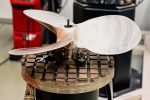
JOME Engineering has produced a replacement marine propeller in Dubai using wire arc additive manufacturing (WAAM), reconstructing it from a 3D scan of the original since no CAD files or tooling were available. The 26 kg stainless steel propeller was printed on a Vipra AM system from Caracol, the Italian large-format additive manufacturing (AM) company, which describes it as the UAE’s first 3D printed marine propeller.
According to Caracol, printing the propeller shortened lead time by about 60 percent and lowered cost by roughly 40 percent compared with casting.
The client asked JOME to rebuild a propeller matching an existing one, and needed it quickly. With no drawings on hand, details such as blade curvature, pitch, and the transition from each blade into the hub existed only in the physical component. Casting a replacement would have meant producing a new die and then waiting weeks in a foundry queue.
JOME instead scanned the original propeller to create a digital master and printed the replacement in SS316L stainless steel on Vipra AM, Caracol’s robotic WAAM platform for large metal parts. The work took place at JOME’s Dubai facility, close to the vessel the propeller was built for.
The team built the propeller in sections, starting with the central hub, or boss, which was machined first. Once a dye penetrant inspection confirmed it was free of cracks and porosity, the three blades were deposited on top of it.
Machining took around 100 hours and was the most demanding step. Propeller blades are twisted freeform surfaces with few usable reference points, so aligning the piece remained difficult even with setting pointers in place.
To keep alignment errors in check, the team re-scanned the propeller after each stage. Each scan was compared against the digital master and used to confirm enough material remained for further cutting. The scans also left JOME with a documented record of the build at every step. Hand grinding, pitch verification, and balancing completed the work.
Deposition accounted for 20 of the project’s roughly 120 hours, with machining and finishing making up the rest. Caracol notes this split is typical for precision metal parts.
Caracol attributes the lead time reduction to skipping die production and foundry queues, which let the vessel return to service sooner. The cost savings come from avoiding tooling, usually the largest fixed expense for a one-off cast propeller, because there is no production run to absorb it.
JOME now holds the propeller’s geometry as a digital file, so a future replacement can go directly to printing without a new scan. Caracol also states that WAAM melts only the wire it deposits and requires no steel die, which it says reduces the carbon footprint of single-unit parts.
The project points to a use case for metal AM in marine maintenance, where a spare may exist only as a physical object. Scanning recovers the geometry that drawings never captured, and WAAM reproduces it directly. According to Caracol, this keeps lead times short and the buy-to-fly ratio low, meaning little raw material is used beyond what ends up in the finished part.
Reverse Engineering Marine Parts Without Drawings
JOME’s propeller addresses a problem in vessel maintenance: replacing a single metal component that has no drawings, when casting it would mean new tooling and weeks of lead time.
The Netherlands Royal Navy’s maintenance company, Marinebaedrijf Koninklijke Marine (MKM), described the missing-drawings side of that problem in 2017. Its CNC coordinator, Ben Jansen, said the organization often lacked drawings or CAD files for parts it needed to repair or replace, including out-of-use parts from older vessels and parts that are inaccessible on a ship. MKM turned to Artec 3D scanners to build digital models from the physical parts, which parallels JOME’s digital master. The scanned models then fed several processes, including 3D printing, CNC milling, injection molding and manual welding. In one case, a damaged landing craft impeller was scanned to locate the damage and then repaired with a robotic welder instead of being replaced entirely.
The WAAMpeller, developed by Damen Shipyards Group with RAMLAB, Promarin, Autodesk and Bureau Veritas, comes closer to JOME’s production method. RAMLAB printed the 400 kg, 1.35-meter tugboat propeller in nickel aluminum bronze (NAB) using WAAM, then CNC milled it to its final finish, a print-then-machine sequence similar to JOME’s. Its starting point was different. The team worked from a 3D CAD file, and Damen project engineer Kees Custers described turning that file into a physical part as the project’s challenge.
JOME’s propeller combines both steps in one repair job, scanning a part with no drawings and rebuilding it through WAAM and machining.
Register now for AMA: Software 2026. Join 3D Printing Industry on 22 October for expert presentations, panel discussions and live audience Q&A exploring the software shaping additive manufacturing. Register here.
To stay up to date with the latest 3D printing news, don’t forget to subscribe to the 3D Printing Industry newsletter or follow us on LinkedIn.
Explore the full Future of 3D Printing and Executive Survey series from 3D Printing Industry, featuring perspectives from CEOs, engineers, and industry leaders on the industrialization of additive manufacturing, 3D printing industry trends 2026, qualification, supply chains, and additive manufacturing industry analysis.
Aura Moreno is a journalist with a BA in Communications whose work spans narrative and cultural storytelling to industry reporting. Aura has hands on experience with 3D printing as co-founder of a jewelry brand which uses the technology. Her interests include how 3D printing is reshaping the way we design